
Health is a public good, sustained by all of us.
Citizenship Health is a community-centered approach to improving long-lasting health outcomes and life success. It is based on the award-winning Asset-Based Paradigm, and it has been tailored to hospital systems, cities, states, schools, and community organizations.
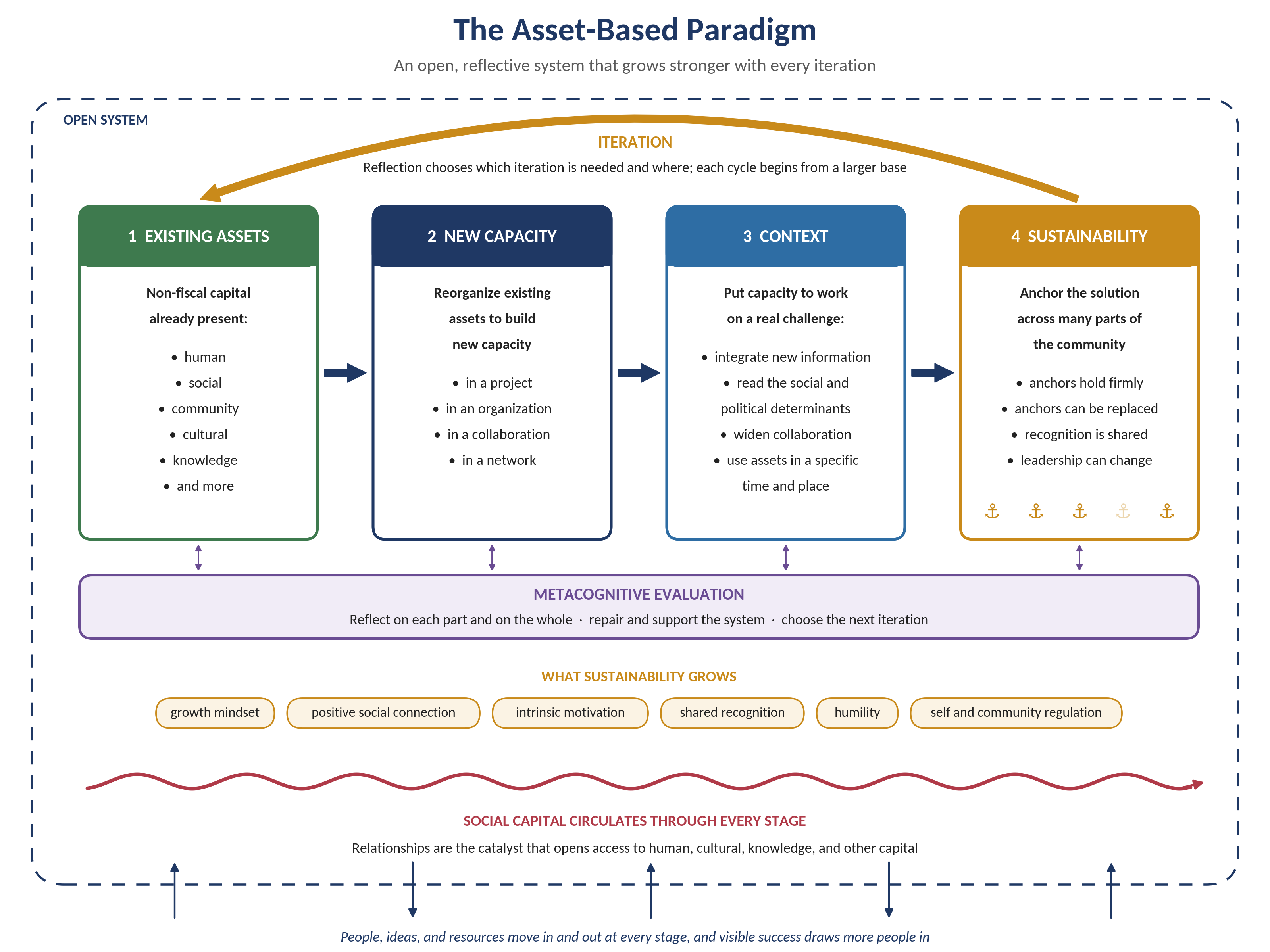
The Asset-Based Paradigm
The Asset-Based Paradigm holds that institutions, communities, schools, and organizations already have tremendous assets that are unrealized and underused. Much time is spent on building new capacity, and much less on leveraging what already exists. As a result, little thought goes to combining existing non-economic assets across systems, and tremendous potential is lost.
Think of a community's assets the way we think of a person's genetic traits. When they are organized, supported, and activated, a person can reach their potential and their best health. The same is true of a community: when we realign the resources that already exist, they can meet the needs of the people living there now.
The paradigm has three movements: recognize the assets that are present (social, human, and cultural capital), reorganize them by pairing people and resources in new ways to build contextual capacity, and sustain the result through open, dynamic systems that learn from both process and outcome.
Recognition
The Asset-Based Paradigm grew out of research recognized with a National Kresge Young Scholar designation and the Best International Paper Award from the Society of Research Administrators International (2011).
Weisblat, G. Z., & Sell, C. (2012). An exemplar in mentoring and professional development: Teaching graduate students transferable skills beyond the discipline. Journal of Research Administration, 43(1), 60-84.
The pillars of Citizenship Health
1. Equity, not just equality
Using research to improve lives. Citizenship Health requires understanding and empathizing with people whose experiences differ from our own. Health and well-being are shaped by context, and the relationships we have in our families and communities carry most of the information and awareness we share. We must think collectively about how to address the social and political determinants of health that so greatly affect our communities.
The pillar in full (FMEC Showcase)
Citizenship Health requires understanding and empathizing with populations that are different from our own experiences. Health and well-being are greatly influenced by context; the relationships we have in our families and communities dictate how most information and awareness is transferred (Christakis). We must therefore think collectively how we can address the Social Determinants of Health that so greatly impact the welfare of our communities.
2. Build and value contextual existing assets
Understanding the power of community. We pay close attention to the resources that already exist within a community: its people, relationships, institutions, places, traditions, and knowledge. When those resources are realigned, they can meet present-day needs in ways that outside programs cannot.
The pillar in full (FMEC Showcase)
Citizenship Health incorporates the assets of a community or organization as akin to the genetic traits of an individual. For an individual, the genetic make-up, if properly organized, supported and activated, allows a person to achieve their potential and maximize their health. Often institutions, communities, schools and organizations have tremendous assets that are unrealized and underutilized (Weinberg, 1999; Zula and Chermack, 2007). While much time is spent on capacity building and creating opportunities for new development, much less effort is expended on leveraging assets to achieve needed ends. As a result, little consideration is given to the combination of existing non-economic assets across resource systems, and tremendous potential is lost. Citizenship Health posits that we must pay closer attention to the tremendous resources that exist within a community, which when realigned can be used to meet the needs of our present-day populations.
3. The ecosystem matters
Realizing that health is necessary for success. Health is an essential part of a person's security and must be seen as a public good. Citizenship Health carries the same rights and responsibilities as any other kind of citizenship. Each person has assets and is connected to the collective, and those whose basic needs are not met may struggle to take part fully.
The pillar in full (FMEC Showcase)
Health is an essential component of one's security, and must be seen as a public good. Citizenship Health entails the same rights and responsibilities as any other type of citizenship. Individuals should expect to receive the health care they require, but at the same time they have a responsibility to themselves and to society to take their health care seriously. Each citizen has assets and is connected to the collective. Those whose basic physiological needs are not met may struggle to meet this goal.
4. Personal responsibility and accountability
Caring for yourself and your community. Our health care system has been built around reacting to crises rather than preventing them, and around health as a commodity rather than a basic need. Citizenship Health asks all of us, individuals and institutions alike, to take shared responsibility for health. Citizenship Health is being an active denizen.
The pillar in full (FMEC Showcase)
Individual self-interest and the narratives that exist within our communities have defined health care over the years in such a way that it is not often seen as a public good. On the supply side, health care workers have been trained in a reactionary manner (fiscal incentives for specific services rather than a preventative care model). On the demand side, consumers maintain an 'emergency room' mentality, knowing that care will be waiting for them if they need it, not investing in a preventative approach. When put together, the two sides have ingrained an intergenerational view of right without responsibility and framed health as a commodity as opposed to a basic need. Citizenship in this country is dependent on a shared vision that we all want to live in a safe place, contribute to society and enjoy a life-style that will allow us to pursue our interests, support our families and be productive members of society. The design of our health care system has embedded it as a good dependent on economic capital rather than as a Maslovian need.
How individuals, groups, and systems shape one another
Citizenship Health reframes health, mental well-being, and violence prevention as relational and civic conditions that emerge through participation in connected systems, not as services delivered to individuals.
The person as an ecosystem
Each person lives inside family, peer, school, community, and institutional systems that shape stress, opportunity, identity, and choice. Each person's actions also ripple outward. The system lives within the individual, and the individual lives within the system.
Determinants as pressure, not destiny
Policy, institutional practice, how resources are distributed, and historical inequity exert real pressure. Determinants shape context, but they do not fully determine behavior. When trust, shared norms, and protective factors are activated, people regain freedom in everyday decisions.
Citizenship as practice
Citizenship is defined by participation, not status. Prevention happens when people take part in groups that model regulation, accountability, empathy, and collective care.
Groups as civic infrastructure
When people engage again and again in stable groups, those groups develop norms that hold members accountable and offer grace in failure. Those norms are protective civic assets, the connective tissue between individual change and community safety.
Reflection and collective learning
Individuals and groups grow by reflecting on what happened, how it was handled, and what could be done differently. Friction is expected in any real system. What matters is how it is recognized, addressed, and learned from.
One connected theory
The Asset-Based Paradigm explains the presence and reorganization of non-fiscal capital. Catalytic Capital explains activation and momentum. Process as Outcome explains durability. Citizenship Health brings them together at the ecosystem level.
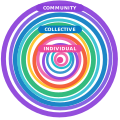
We read the rings from the outside in
Cut across a tree and you can read its history. Wide rings are good years. Narrow rings are droughts. Scars show the fires and storms it grew around, and even a fallen branch carries rings that tell how long it lived. The rings read together tell the story of the whole tree.
Communities carry their history the same way. The Citizenship Health Institute reads the nested rings from the outside in: the community changed, which changed the collective (a family, organization, or movement), which changed the individual. Starting with the community lets us see where it thrived, where it struggled, and which assets carried it through.
Our partner, Strengthening Our Students, reads the same rings from the inside out, starting with the student and moving to the family, community, and greater good. Together the two directions give the full picture.
IDEAS: how HPAC teams carry out projects
Every HPAC project, and many of the projects we support, moves through five stages. The three levels of change, individual, collective, and community, run through every stage.
Identify
Name a challenge in the community and the assets already present to address it.
Develop
Research the issue with credible evidence and develop a response with the community.
Enact
Put the response to work by talking with people, building teams, and making connections.
Assess
Look honestly at what happened, what changed, and what we learned.
Share
Share the work so others can build on it, at Scholars Day and beyond.
The community-centered CIRCLE model, which guides the Community Journal, is described on the Journal page.
Licensing and training
The Citizenship Health framework is a licensed model that can be tailored to the outcomes a hospital system, city, state, school, or organization wants to reach. Fees from licensing and training help fund CHANGE programs when grant funding has gaps.
Ask about licensing